
What Is AI? A Plain-English Guide Beyond “ChatGPT”
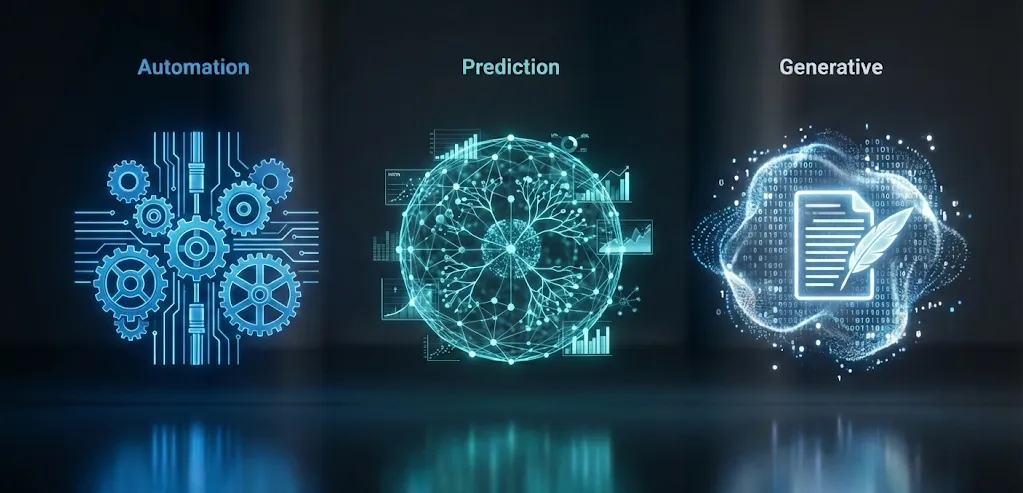

AI isn’t one thing you buy. It’s a family of tools, and the fastest way to waste money is to treat them all like they behave the same.
We hear business leaders say “AI” and picture ChatGPT. That’s understandable—but it’s also where the confusion starts. Because “AI” can mean three very different kinds of systems, and they carry very different levels of risk in production.
First, there’s plain automation: rules-based workflows. If this happens, do that. It’s not glamorous, but it’s reliable. It’s great when a process is stable—approvals, routing, reminders, checklists. The downside is it breaks when reality gets messy. The moment you have exceptions, edge cases, or people using the process in ways you didn’t predict, the rule list grows until the “automation” becomes a maintenance job.
Second, there’s prediction—what most people mean by machine learning. This isn’t magic either. It’s a pattern engine trained on historical data that gives you a score or likelihood. “This lead is likely to convert.” “This customer is likely to churn.” “This transaction looks unusual.” In the real world, this is powerful for prioritization and classification—quietly improving decisions at scale. The trade-off is that it depends on data quality and it can drift. If your business changes, your model can become stale. Machine learning is a likelihood meter, not truth.
Third, there’s generative AI—the part of the industry everyone is talking about. This is the ChatGPT-style category, but it’s bigger than chat. It drafts, summarizes, rewrites, extracts information, and increasingly it works across documents, spreadsheets, audio, and images. In plain terms: it’s an extremely capable “first pass” assistant for knowledge work. It can turn meeting notes into a proposal draft, summarize a thread of customer emails into themes, classify incoming requests, or help employees find answers inside internal docs.
Here’s the part that matters; generative AI is powerful, but it’s not reliably deterministic. Traditional software gives you the same output every time if you give it the same input. Generative systems give you a good output most of the time—and then occasionally they’re wrong. That’s not a moral failing. It’s just how these systems work.
This is why we’re deliberate about strategy in 2026. If the output can affect money, reputation, compliance, safety, or customer trust, the correct posture is not “let it run.” It’s augmentation with accountability: AI takes the first pass, humans review, and responsibility stays with people.
That approach isn’t slower. In practice, it’s the only approach that scales without breaking trust. You still get the speed. You still get the leverage. But you don’t pretend the tool is a flawless decision-maker. You design the workflow so that when the model is wrong—and it will be sometimes—the business doesn’t absorb the damage or absorbs an anticipated trade-off.
If you’re wondering where to start without creating anxiety inside the team, start where review is easy and the cost of being wrong is low. Summaries are a great example: meeting notes, tickets, customer emails, vendor documents. Drafting is another: emails, proposals, SOPs, job posts. Triage and categorization are often a quick win too—routing requests, tagging tickets, prioritizing messages—because it’s decision support, not final authority. And internal Q&A can be useful when it points back to the source documents, so employees can verify instead of blindly trusting a generated answer.
The goal isn’t to turn your business into a science project. It’s to make your people faster and more consistent while maintaining full control over autonomy. Most companies don’t need “AI everywhere.” They need a few well-chosen workflows where AI does the heavy lifting up front and humans stay in control at the end.
If you’re trying to make sense of the noise, don’t ask, “How do we automate everything?” Ask, “Where can generative AI take the first pass so our people can make the final call?” That one question will keep you out of trouble—and it’s also where the real ROI is right now.
The three kinds, as real projects
Classification, generation and applied machine learning are different tools with different risks. Here is one of each, in production.
Want to know where generative AI can take the first pass so your team can make the final call?
Start by taking our AI Readiness Assessment to measure your current data and infrastructure. Your results will provide the exact baseline needed to take the next steps and safely turn those insights into working solutions.